

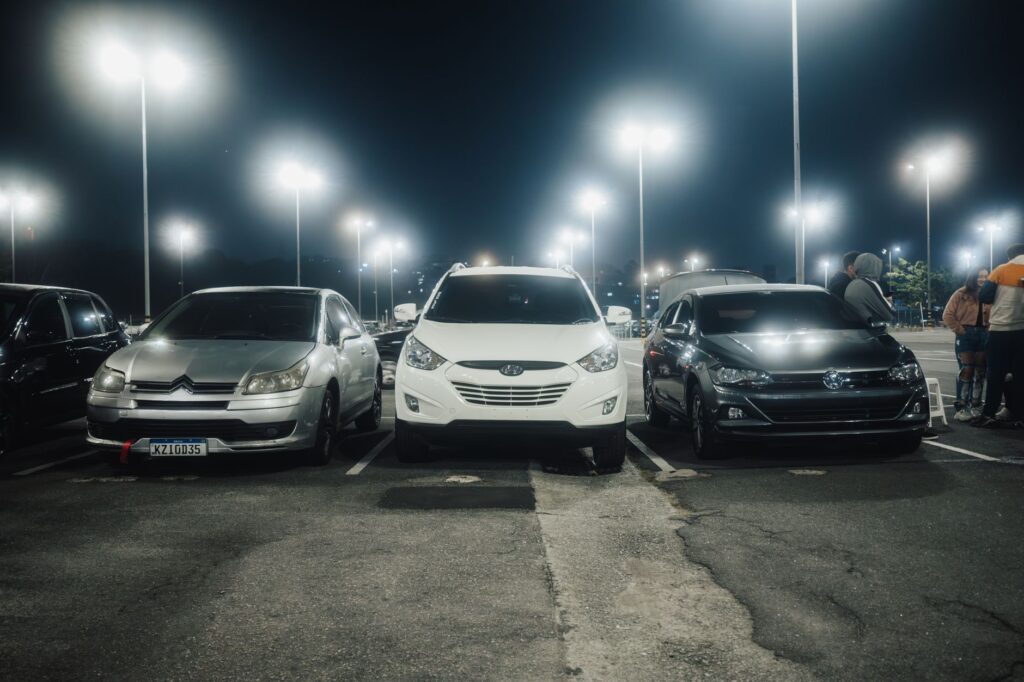
Councils and police in England and Wales can stop street cruising and noisy car meets using three main tools: Public Spaces Protection Orders, police dispersal powers and community protection notices. Each works differently, and which one fits depends on where the problem is and who is causing it. These car meets police powers are used most often in retail parks and industrial estates, where empty car parks fill up after the shops close.
Most gatherings are harmless. The trouble comes from a minority: revving and backfiring, burnouts, racing on estate roads, litter and intimidating crowds. The law targets behaviour, not car ownership.

What are the main powers used against car meets?
The three powers come from the Anti-social Behaviour, Crime and Policing Act 2014, with separate road traffic law sitting alongside. A Public Spaces Protection Order (PSPO) is made by a council for a defined area. A dispersal power is used by police to move people on. A community protection notice (CPN) is aimed at a named person or business. The government’s guidance on anti-social behaviour powers is published at gov.uk.
| Power | Who issues it | Covers | Typical use | Weakness |
|---|---|---|---|---|
| PSPO | Council, after consultation | A defined area, for up to three years before review | Banning revving, racing, stunts or gathering for the purpose in a retail park | Slow to introduce; needs evidence and enforcement staff |
| Dispersal order | Police (inspector or above authorises) | A set area, up to 48 hours | Clearing a meet that is causing harassment or alarm | Short-term; people can return later |
| Community protection notice | Council or police | A person, business or landowner | Forcing a site owner to secure a car park, or warning an individual | Needs a written warning first |
How do PSPOs work on retail parks and industrial estates?
A PSPO lets a council ban specific activities in a named area where they have a persistent, unreasonable effect on the quality of life of people nearby. The council must consult the police and the public, and publish the order. Breach can bring a fixed penalty notice, currently capped at £100 for most PSPO breaches, or prosecution.
Car park PSPOs usually list particular behaviours: sounding horns or revving engines to cause annoyance, racing, performing stunts, and playing amplified music. Many also cover private land, but only where the council can show the effect is on the public. Signs at entrances are a legal and practical necessity.
The weakness is enforcement. An order on paper does little if nobody is there at 10pm on a Friday. Some councils pair PSPOs with wardens or camera systems; our piece on neighbourhood wardens looks at what they can and cannot do.
When do police use dispersal powers?
Police can use a section 34 dispersal direction when a group’s presence is causing, or likely to cause, harassment, alarm or distress, or crime and disorder. An officer can order people to leave an area and not return for up to 48 hours. Failing to comply is an offence.
Dispersal suits a one-off flashpoint, such as a large unannounced meet. It does not solve a weekly problem, and organisers often move to the next estate. That is why forces tend to combine it with road traffic powers: section 59 of the Police Reform Act 2002 lets officers warn drivers about careless or anti-social driving and seize a vehicle on a second incident within 12 months. Noisy exhausts and unroadworthy modifications can also bring fines or prohibition notices.
What is a community protection notice?
A community protection notice is a written order requiring a person or organisation to stop behaviour that harms the local community or to take steps to fix it. The council or police must first issue a written warning and give time to comply. Failure to comply is a criminal offence, with a fixed penalty or court fine.
For car meets, the CPN often lands on the landowner or the business that controls the car park. It can require barriers, closed gates at night, lighting or security. Organisers of regular meets, where identifiable, can be named too. A CPN is slower than dispersal but can bring a lasting fix.
Which power fits which problem?
For a recurring weekend meet on one estate, a PSPO plus a CPN on the site owner usually works best. For a sudden large gathering tonight, dispersal and road traffic powers are the realistic tools. For a handful of repeat offenders, vehicle warnings, seizure and named notices fit better than blanket bans.
Residents rarely choose the tool. What they can do is supply the evidence that makes the choice possible.
What can residents report, and how?
Use 999 only when there is danger to life or a crime in progress, such as dangerous racing with people at risk. For ongoing noise or disorder, call 101 or use your force’s online form. Noise, litter and obstructed access can go to the council’s environmental health or community safety team.
Useful reports include dates, times, locations, vehicle registrations where safely visible, and how the noise or behaviour affects you. Keep a simple log over several weeks. Councils need a pattern of incidents to justify a PSPO, and a log from several households carries real weight. Do not confront drivers or film in a way that puts you at risk.
It also helps to know what is on the road. Many exhaust and suspension complaints involve modifications that would not survive a test, and Motor Trades has a guide to what testers fail: further reading: modified cars and the mot: what testers will actually fail.
If the nuisance is tied to late-night venues instead, the licensing route is different, and we cover it in your rights as a resident under night-time licensing. Ask your local council which PSPOs are already in force near you, as the list is usually on its website.


Leave a Reply