

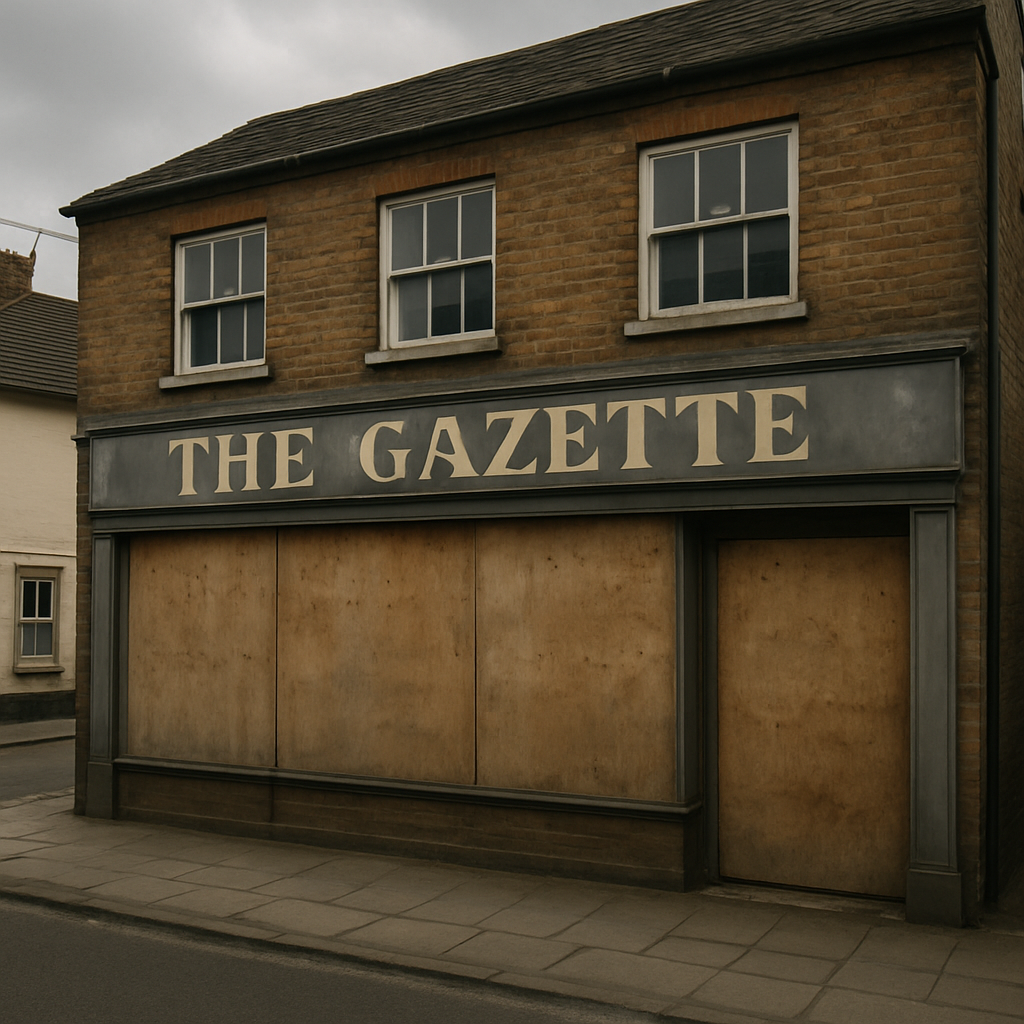
There is a quiet crisis happening across Britain. Not the kind that makes front pages or leads the evening bulletin, but the kind that unfolds slowly, almost invisibly, until one day you realise the newspaper that once covered your town’s planning rows, magistrates’ court, and school fundraisers simply no longer exists. The term coined for this phenomenon is a local news desert, and the local news desert UK problem is far more widespread than most people realise.
A local news desert is defined as a geographic area where residents have little or no access to credible, regular, locally focused journalism. No weekly paper. No local radio news team reporting from the council chamber. No reporter turning up to ask why the new housing estate was waved through without adequate road infrastructure. Just silence, where accountability once lived.
How Bad Is the Problem Across the UK?
The scale of what has been lost is striking. According to research by the Press Gazette and the Reuters Institute for the Study of Journalism at the University of Oxford, the UK lost more than 300 local and regional news titles between 2005 and 2025. That is not just a statistic for media scholars to fret over. It represents the closure of newsrooms in places like Hartlepool, Wrexham, parts of the Scottish Highlands, and swathes of rural Wales, where the nearest surviving local title might now be published 30 or 40 miles away.
Reach plc, which publishes the Manchester Evening News, the Liverpool Echo, and dozens of other titles, has faced repeated rounds of redundancies. Johnston Press collapsed entirely in 2018, placing titles including The Scotsman and the Yorkshire Post into new ownership under uncertain conditions. Even where titles survive in name, many have been reduced to skeleton editorial teams publishing largely repurposed content, wire copy, or search-engine-optimised articles bearing little relation to genuine community journalism.
Rural and post-industrial areas tend to suffer most acutely. Research from the Media Reform Coalition has identified large stretches of mid-Wales, County Durham, Lincolnshire, and parts of Northern Ireland as regions where local news provision has shrunk to near-nothing. Urban areas are not immune either. Several London boroughs, particularly in outer east London, have lost their dedicated local papers entirely in the past decade.
Why Does Local News Die?
The economics are brutal and fairly well understood. Classified advertising, once the financial backbone of the local press, migrated permanently to platforms like Rightmove, Indeed, and Gumtree in the early 2000s. Display advertising followed readers onto social media. Print circulations fell. Digital revenues never came close to replacing what was lost.
Ownership consolidation accelerated the decline. When a single regional publisher owns 30 titles and faces financial pressure, the temptation is to slash reporters across the board rather than protect individual newsrooms. A paper that once had eight journalists covering a medium-sized market town might be reduced to one part-time reporter filing three stories a week, most of them press releases lightly rewritten.
Younger readers, meanwhile, have largely stopped seeking out local titles at all, either in print or online. The BBC’s local news provision, stretched as it is, fills some of the gap, but its editorial remit cannot realistically cover every village hall dispute, every planning application, or every local magistrates’ case that a dedicated local newsroom once tracked.

What Happens to a Town Without Local Journalists?
This is where the consequences move well beyond media industry statistics and into something that affects daily civic life. Democratic accountability depends, at least in part, on journalism. When no one is watching the council, the council notices.
Studies in the United States and, more recently, in the UK have found measurable effects in areas that lose local news coverage. Voter turnout in local elections falls. Council spending increases without corresponding scrutiny. Planning decisions that might once have prompted organised public opposition slip through unchallenged. Local authority misconduct goes unreported. Vulnerable residents who once had a local champion, a reporter willing to pursue a story about a housing association or a poorly run care home, lose that voice entirely.
There is also the social fabric to consider. Local journalism, at its best, tells communities back to themselves. It names the people who win local awards, covers the under-15s football club, reports on the campaign to save the high street library. When that disappears, something less tangible but equally real is lost: a shared sense of what is happening and what matters locally.
The BBC has itself acknowledged the gap that local news closures leave, and its own local democracy reporters scheme, a partnership with news publishers, was designed specifically to place journalists back inside council chambers. It helps, but it covers only a fraction of what has been lost.
Are There Any Signs of Recovery?
There are green shoots, though calling them a recovery would be too strong. Hyperlocal news sites, many run by volunteers or tiny editorial teams, have filled gaps in places like Swindon, Leeds, and Leamington Spa. The membership-funded model, popularised by outlets like the Bristol Cable, offers one possible path forward. Some local authority areas have begun considering public interest journalism funds, though critics rightly flag the independence concerns that come with council-backed news.
Ofcom’s annual news consumption reports have repeatedly highlighted public appetite for trusted local news, even as commercial provision shrinks. That gap between what people want and what the market currently delivers is significant. It suggests demand exists; the challenge is finding sustainable funding models that do not compromise editorial independence.
Could Your Town Be at Risk?
The honest answer is: possibly. If your area is served by a single title owned by a large regional publisher, if that title has reduced its print frequency, if the reporter covering your council is also covering three other councils, the warning signs are there. Rural areas, smaller market towns, and post-industrial communities outside major city centres are statistically most at risk of becoming or deepening into a local news desert.
Paying attention to what you still have is a reasonable starting point. Supporting independent local journalism, sharing stories, engaging with community news organisations, and pushing local representatives to take the issue seriously all matter. Because once a newsroom closes, it rarely reopens. And the silence that follows is not neutral. It has consequences.
The local news desert UK crisis is not just a story about struggling media businesses. It is a story about the kind of communities we want to live in, and whether anyone will be there to tell us what is happening inside them.
Frequently Asked Questions
What is a local news desert in the UK?
A local news desert is an area where residents have little or no access to regular, credible local journalism. In the UK, this typically means a town or region where local newspapers have closed and no broadcaster or online outlet has replaced them with meaningful community coverage.
Which parts of the UK are most affected by local news deserts?
Research points to mid-Wales, parts of County Durham, rural Lincolnshire, sections of Northern Ireland, and several outer London boroughs as among the worst affected areas. Post-industrial and rural communities tend to lose local press provision faster than major urban centres.
Why are local newspapers closing across the UK?
The primary cause is the loss of classified and display advertising revenue to digital platforms, combined with falling print circulations. Ownership consolidation has also led to repeated rounds of redundancies, leaving many surviving titles with only one or two reporters covering large areas.
Does losing local news actually affect democracy?
Evidence suggests it does. Areas that lose local journalism tend to see lower turnout at local elections, reduced scrutiny of council decisions, and less public awareness of planning and spending matters. Without reporters in council chambers, accountability mechanisms weaken.
What is being done to tackle local news deserts in the UK?
The BBC’s local democracy reporters scheme places journalists inside councils in partnership with surviving publishers. Hyperlocal outlets and membership-funded news organisations like the Bristol Cable offer alternative models. Ofcom continues to monitor the issue, though no comprehensive national funding solution is currently in place.
Leave a Reply