

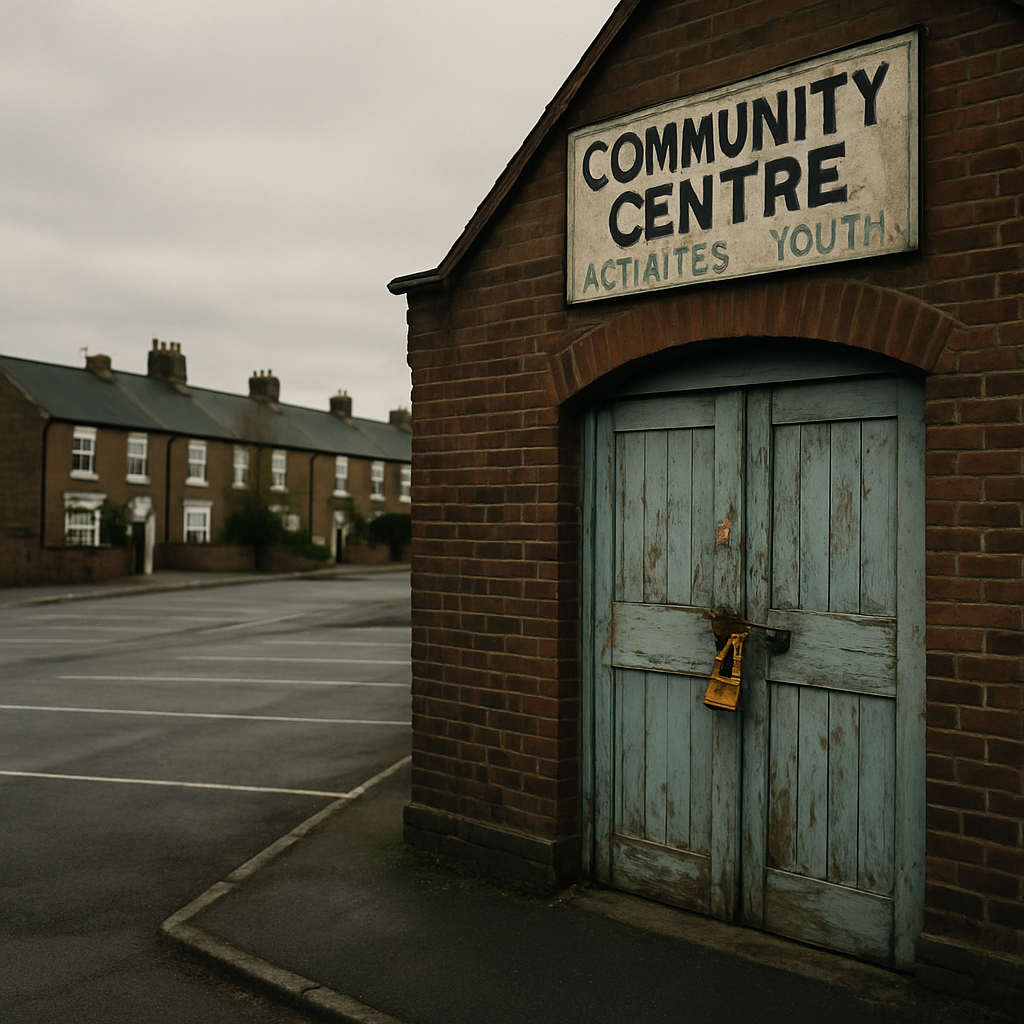
Walk past the old community centre on any weekday evening and you might notice the same thing in towns right across the country: the lights are off, the doors are padlocked, and a slightly faded sign still advertises a youth club that stopped running four years ago. Youth services cuts have quietly reshaped what is available to young people in local areas, and the full picture is considerably bleaker than most residents realise.
Over the past twelve years, local authorities in England, Scotland and Wales have faced relentless pressure to reduce spending. Youth services, which have no statutory requirement attached to them in the way that adult social care and schools do, have absorbed a disproportionate share of those reductions. Research published by the BBC and corroborated by sector bodies has estimated that England alone lost more than 4,500 youth worker posts and closed over 750 youth centres between 2012 and 2024. Wales and Scotland recorded smaller but proportionally significant reductions too, with Welsh councils cutting dedicated youth budgets by an average of 44 per cent across the same period.
Which Facilities Have Closed and Which Are Hanging On?
The closures have not been evenly spread. Rural and post-industrial areas have generally fared worse than city centres, where charitable endowments and university partnerships have sometimes cushioned the blow. Coastal towns in particular tell a stark story: in parts of the North East, South Wales valleys, and East Anglia, entire districts now have no publicly funded, drop-in youth provision at all.
What remains tends to fall into a few categories. Some leisure centres still run subsidised sessions, though opening hours have typically been cut and concession prices have risen. A number of sports pitches survive under council management, but many now sit behind booking systems that presuppose a smartphone and a debit card, effectively excluding the teenagers most in need. After-school clubs attached to secondary schools have broadly held up, but they are school-term-only and inaccessible to young people who have already left education.
In several boroughs, the buildings themselves remain standing but have been leased to private operators, converted to paid-for leisure rather than free or low-cost community use. The physical fabric is there; the open-door policy is not.
Who Is Filling the Gap After Youth Services Cuts?
The vacuum left by statutory withdrawal has not gone unnoticed. Charities, parish councils, faith groups and community organisations have stepped in where they can, though most are frank about the limits of what they can sustain.
The National Citizen Service Trust, Street League, and local equivalents like Oasis Community Learning have expanded programmes, particularly in urban areas. In rural England, parish councils have increasingly taken on youth provision as an informal responsibility, organising summer holiday sessions or funding small grants to keep a village hall open on Friday nights. Some have done impressive things with modest budgets.

Charities are particularly inventive at finding funding streams. One youth organisation in Stoke-on-Trent recently used a combination of a National Lottery grant and community fundraising to refit a derelict workshop as a maker space, offering local teenagers access to tools and creative projects, including 3d printing services, laser cutting and electronics. The project had a waiting list within weeks of opening. It is the kind of outcome that illustrates both what is possible and how dependent it is on a patchwork of goodwill and competitive grant funding that could disappear at any renewal cycle.
Faith communities have also quietly become significant providers. Mosques, churches and gurdwaras across the Midlands, London, and Yorkshire run youth sessions that are open to all, not just their congregations, filling evenings and weekends that would otherwise be entirely unoccupied. These groups rarely appear in local authority statistics, which means the true volume of informal provision is almost certainly undercounted.
What Does the Evidence Say About Youth Provision and Antisocial Behaviour?
There is a well-established debate about whether youth clubs actually reduce antisocial behaviour, and it is worth engaging with honestly rather than assuming the answer. The evidence is mixed, but the balance of it leans in one direction.
A 2023 report from the Centre for Social Justice found a statistically significant correlation between areas that had experienced the deepest youth services cuts and subsequent rises in recorded antisocial behaviour incidents, particularly between 17:00 and 22:00. That is not a surprise to anyone working in community policing. Several police and crime commissioners have said publicly that the loss of youth provision is one of the clearest contributing factors they observe in knife crime hotspots.
Correlation is not causation, and young people are not inherently problematic. The more precise argument is about opportunity cost: when young people, particularly those from lower-income households, have nowhere to go and nothing structured to engage with, the risks of exposure to criminal networks and the likelihood of boredom-driven incidents both rise. Youth workers themselves often describe their role as being the trusted adult in a young person’s life, which matters enormously when family situations are difficult.
Scotland has taken a somewhat different policy path, embedding youth work more consistently within its community planning partnerships under the Community Empowerment Act. Early indicators suggest this has helped maintain provision levels in some areas, though budget pressures remain acute in authorities like North Ayrshire and Clackmannanshire.
What Can Local Residents Do About It?
The first thing is to find out what actually exists in your area. Most councils publish a community directory, and many local Volunteer Centres maintain searchable databases of active youth organisations. It is worth checking what your local authority’s current youth services budget is and how it compares to a decade ago, information that should be available via a Freedom of Information request if it is not published proactively.
If you are in a position to volunteer, local youth organisations almost universally need more adults willing to help run sessions or accompany trips. Many offer free training and DBS checks. Parish councils and community forums are also worth attending if youth provision is something you feel strongly about, since decisions about discretionary spending often happen at precisely that level.
Campaigning groups like the National Youth Agency have been pressing for a statutory duty around youth services for several years. Whether or not that legislative change eventually comes, the conversation about what is left for young people in local areas is one that every community deserves to be having openly.
The Picture Going Into 2026
Local authority finances remain under considerable strain, and there is no realistic prospect of a sudden reversal of the past decade of youth services cuts. The Autumn 2025 spending review offered some additional funding for targeted youth violence reduction programmes, but general open-access provision was largely absent from the settlement.
What that means, practically, is that the charities, volunteers, and parish councils who have been holding things together will continue to carry the weight. They deserve recognition, proper infrastructure funding, and longer grant cycles that allow them to plan beyond twelve months at a time. Young people in your area deserve no less than that.
Frequently Asked Questions
How much have UK youth services budgets been cut since 2010?
Estimates vary by region, but research suggests English councils cut youth services spending by around 70 per cent in real terms between 2010 and 2024. Welsh councils averaged cuts of roughly 44 per cent over the same period, with Scotland experiencing smaller but still significant reductions in many local authority areas.
Are councils legally required to provide youth services?
No. Unlike adult social care and children’s education, youth services carry no statutory duty in England or Wales, meaning councils can reduce or eliminate provision without breaking any legal obligation. Scotland has slightly stronger community planning frameworks, but provision is still largely discretionary.
Do youth clubs actually help reduce antisocial behaviour?
The evidence broadly supports a link between structured youth provision and lower rates of antisocial behaviour incidents, particularly during evening hours. A 2023 Centre for Social Justice report found a correlation between deep youth services cuts and subsequent rises in recorded antisocial behaviour, though researchers note that youth provision is one factor among many.
Which charities are filling the gap left by council youth services?
Organisations including Street League, the National Citizen Service Trust, Oasis Community Learning, and hundreds of smaller local charities are active across England, Scotland and Wales. Faith communities and parish councils have also become significant informal providers in many areas, particularly in rural communities.
How can I find out what youth services exist in my area?
Start with your local council’s community directory or contact your local Volunteer Centre, which typically maintains a database of active youth organisations. You can also submit a Freedom of Information request to your council asking for current youth services budget figures compared to ten years ago.
Leave a Reply