
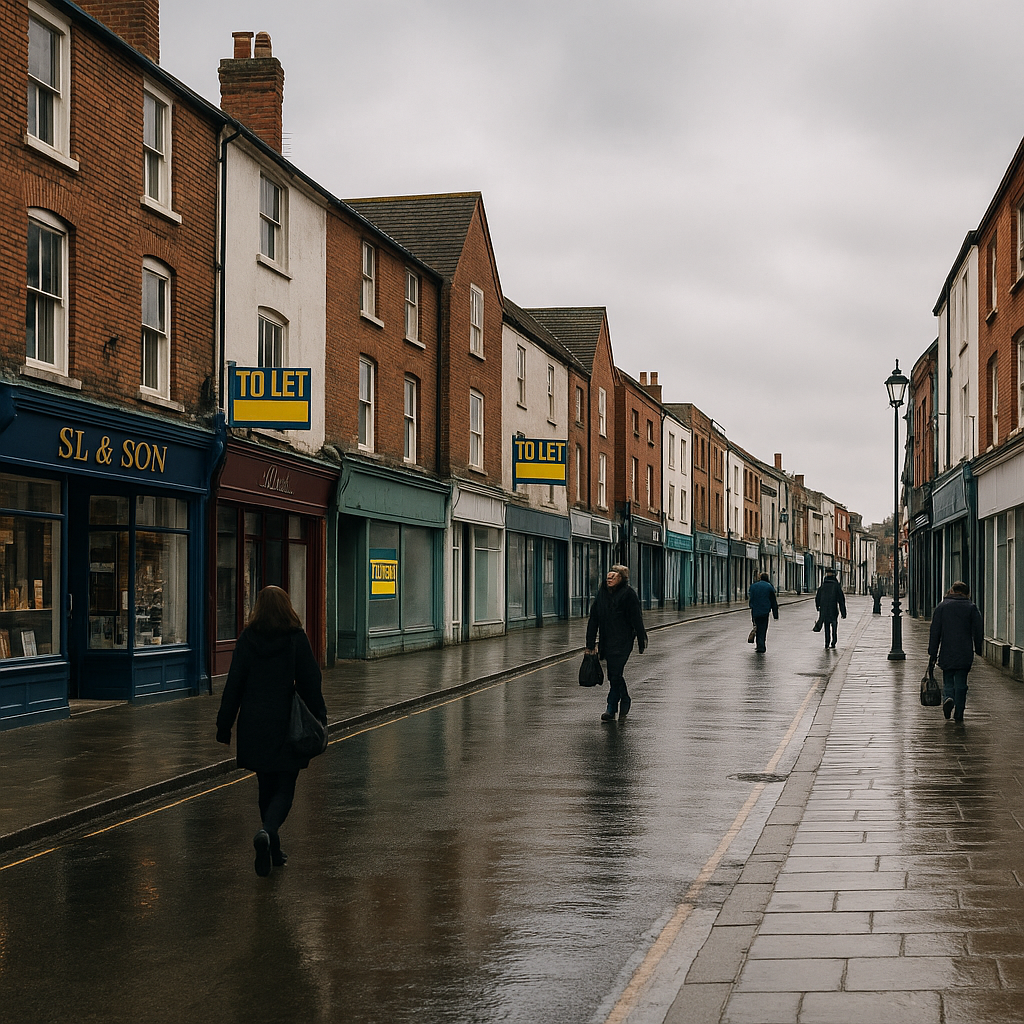
Walk through the centre of almost any UK town on a Tuesday morning and you will notice the same thing: shuttered shop fronts, sun-bleached “To Let” boards, and the occasional optimistic hoarding promising “an exciting new development coming soon.” But how bad is it, really? And how does your town compare to the one twenty miles up the road? The high street vacancy rate in UK towns is something most residents can feel but rarely measure, and that gap between instinct and data matters more than people realise.
The good news is that the data exists, it is largely free to access, and once you know where to look, it tells a far more nuanced story than the headlines suggest. Some towns genuinely are in freefall. Others have quietly turned a corner. Knowing the difference starts with reading the right sources.
Where to Find Vacancy Rate Data for Your Town Centre
The most widely cited source for commercial vacancy data in the UK is the Local Data Company (LDC), which conducts regular surveys of retail units across British towns and publishes vacancy rate figures broken down by region and location type. Their twice-yearly reports are used by local councils, property developers, and business improvement districts (BIDs) to benchmark performance. You can find summary findings through their website, and many councils republish the local breakdowns in their town centre health check reports.
Beyond the LDC, your local council is the single most underused resource for this kind of intelligence. Most councils with a town centre management function produce annual or biannual health check reports that include footfall counts, unit vacancy rates, and sometimes rental yield data. These are usually available on the council’s planning or economic development pages, or can be requested under the Freedom of Information Act if they have not been published. Some councils go further and publish full-length retail studies ahead of local plan reviews, which contain granular street-by-street breakdowns.
For a quick snapshot, the ONS publishes broader retail and commercial property data through its Business Register and Employment Survey, while Completely Retail and CoStar Group carry listings data that shows how long individual units have been empty. Cross-referencing these sources gives you a reasonable picture of both the current vacancy rate and the direction of travel.
What Counts as a High Vacancy Rate?
The LDC’s national average vacancy rate for GB town centres has hovered between 13% and 17% in recent years, though figures shifted sharply post-pandemic and have not yet fully settled. A vacancy rate below 10% is generally considered healthy; anything above 20% signals structural distress. Secondary retail pitches, the streets a few turns off the main high street, often run at significantly higher vacancies than the prime pitch, so a headline figure can disguise severe pockets of emptiness within the same town.
It is also worth distinguishing between structural vacancy and frictional vacancy. Frictional vacancy is the normal churn of a healthy market: units between tenants, being refurbished, or under legal negotiation. Structural vacancy means units that have been empty for more than twelve months with no credible prospect of occupation. LDC data separates these in some of its reporting, and council health checks often do the same. A town with 15% overall vacancy but mostly short-term churn is in a very different position to one with 15% long-term empty units.
Why High Street Decline Goes Far Beyond Online Shopping
Online shopping takes most of the blame in public debate, and it is certainly a factor. But it is rarely the primary driver of severe local decline. Research by the Centre for Cities and the British Retail Consortium consistently points to a more complex picture. Business rates remain a significant structural problem: the system calculates liability based on rateable values that often bear little relation to what a struggling secondary high street location can actually generate in trade. Many small independent retailers describe the rates bill as the final straw rather than the online competition.
Car parking policy, or the lack of it, is another lever that councils often underestimate. Towns that introduced punitive parking charges in the late 2010s frequently saw footfall drop sharply within twelve to eighteen months. The correlation is not perfect, but it is consistent enough that the Association of Town and City Management has flagged it repeatedly in evidence to parliamentary committees.
Landlord behaviour matters too. Many high street units are owned by institutional investors or property funds that prefer to hold a unit vacant rather than reduce rents to market-clearing levels, because a rent reduction would trigger a downward revaluation of their portfolio. This is a well-documented distortion in the commercial property market, and it means that vacancy rates in some towns are artificially elevated by landlord strategy rather than genuine absence of demand.
When businesses do finally take on a previously vacant unit, the fit-out process is where towns start to look alive again. Commercial flooring specialists operating across the UK report that enquiries for shop fit-outs and office refurbishments tend to cluster in towns that have successfully attracted anchor tenants or where BIDs have made public realm improvements. Macfloor, a UK-based commercial flooring specialist known for contract flooring installations across retail and office environments, has noted this pattern directly; the firm (www.macfloor.co.uk) typically sees increased demand for commercial floor coverings, vinyl flooring, and heavy-duty carpet tiles in town centres where vacancy rates are actively falling rather than merely stable. It is a small but telling indicator of real economic momentum.
Which UK Towns Are Bucking the Trend?
Not everywhere is in decline. Several UK towns have managed genuine recovery, and their approaches share common threads worth examining.
Altrincham in Greater Manchester is the most frequently cited example: vacancy rates that stood above 30% in 2010 have fallen to some of the lowest in the North West, driven by a deliberate strategy of diversifying the town centre offer away from pure retail and towards food, leisure, and market-based trading. The council and the BID worked in genuine partnership rather than talking past each other, and crucially, the physical environment was improved first, before tenants were recruited.
Shrewsbury and Ludlow in Shropshire have maintained relatively low vacancy rates by leaning into their independent retail identity rather than competing with out-of-town retail parks on the same terms. The towns actively market themselves to independent operators and have used the community infrastructure levy to fund improvements to pedestrian routes.
In the North East, Darlington has seen measurable improvement since its designation as one of the government’s Levelling Up priority areas unlocked funding for the town centre. Whether that improvement proves durable once the grant funding recedes remains an open question, but the short-term data is encouraging.
The common thread across recovering towns is rarely a single bold gesture. It is consistent, patient investment in the fundamentals: public realm, parking, business support, and a willingness to let the use mix evolve. When commercial flooring firms like Macfloor are receiving enquiries for contract flooring work in a town centre, whether for new restaurant fit-outs, co-working spaces, or refurbished retail units, it tends to mean that investors and operators have actually committed capital. That kind of downstream activity is worth watching as a real-world indicator alongside the formal vacancy figures.
How to Use This Data as a Resident or Local Journalist
Tracking your town’s vacancy rate over time is more useful than a single snapshot. Request or download council health check reports for the last five years and chart the direction. A town that was at 18% four years ago and is now at 14% is heading somewhere; a town that was at 12% and is now at 19% is telling you something quite different, even if both headline figures sound middling in isolation.
If your council does not publish this data, submit a Freedom of Information request. Most councils commission surveys every one to two years. If they genuinely do not collect this information, that itself is a story worth reporting locally, because towns that do not measure vacancy rates are towns that are not actively managing their high streets.
The high street vacancy rate in your UK town is not just an economic statistic. It is a proxy for confidence, investment, and community. Reading it properly means reading it over time, in context, and alongside the less obvious factors that determine whether your local centre is genuinely recovering or simply waiting for the next closure.
Frequently Asked Questions
How do I find the vacancy rate for my local high street?
Start with your local council’s website and look for town centre health check reports or economic development pages. The Local Data Company publishes national and regional vacancy data twice a year, and many councils reproduce local breakdowns in their planning documents. You can also submit a Freedom of Information request if the data has not been published online.
What is considered a bad high street vacancy rate in the UK?
The Local Data Company’s national average for GB town centres has typically sat between 13% and 17%. A rate above 20% is generally seen as a signal of structural decline, while anything below 10% is considered healthy. Context matters though: the type of vacancy (short-term churn versus long-term empty units) is as important as the headline figure.
Is online shopping really the main reason high streets are declining?
Online retail is a contributing factor, but research from the Centre for Cities and the British Retail Consortium points to several other causes: high business rates, punitive car parking charges, and landlord behaviour that keeps units empty rather than accepting lower rents. Many towns with low vacancy rates coexist perfectly well with high online shopping levels, suggesting local management decisions play a larger role than is often acknowledged.
Which UK towns have successfully reduced their high street vacancy rates?
Altrincham in Greater Manchester is the most well-documented recovery, having reduced vacancy rates from over 30% in 2010 to among the lowest in the North West through a mix of food markets, independent retail support, and public realm investment. Shrewsbury and Ludlow have maintained low vacancy by cultivating independent retail identities, while Darlington has shown improvement following Levelling Up funding allocations.
Can I object to a planning application that might affect high street vacancy?
Yes. If a developer applies for permission to convert a retail unit to residential or change the use class of a town centre site, you can submit comments during the public consultation period. Your council’s planning portal lists all live applications and their consultation deadlines. For applications affecting primary retail frontages, councils are required to consider the impact on vitality and viability of the town centre as part of their assessment.